


 DE
DE  EN
EN  Swiss Broadcast Edition Volume 8
Label: Triston Master Recordings SCHOPPER Edition TMR-SE 0020
Gatefold cover, 180 Gramm Pressing
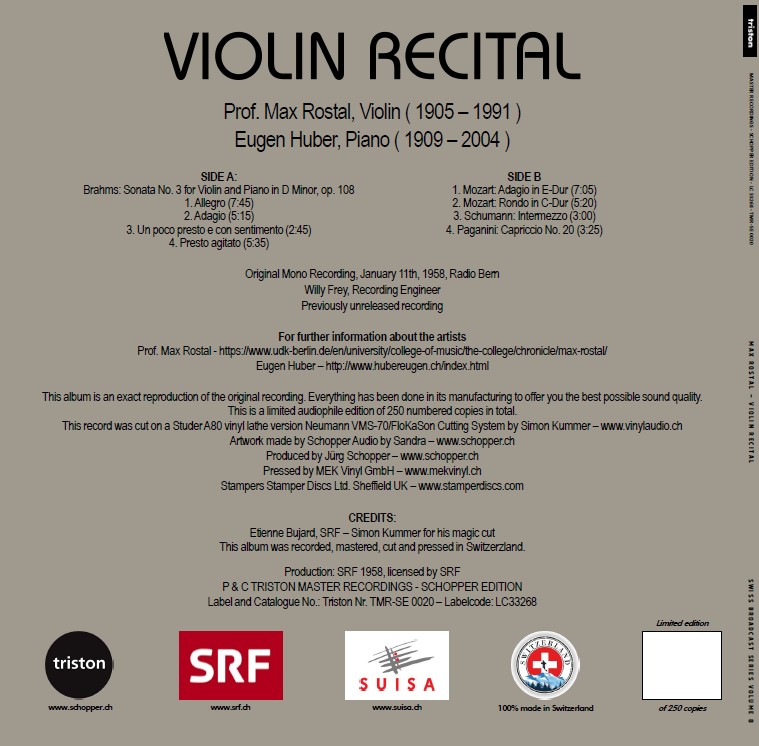
Original Mono Recording, January 11th 1958, Radio Bern. First publication.
Violin: Max Rostal
Piano: Eugen Huber
Program:
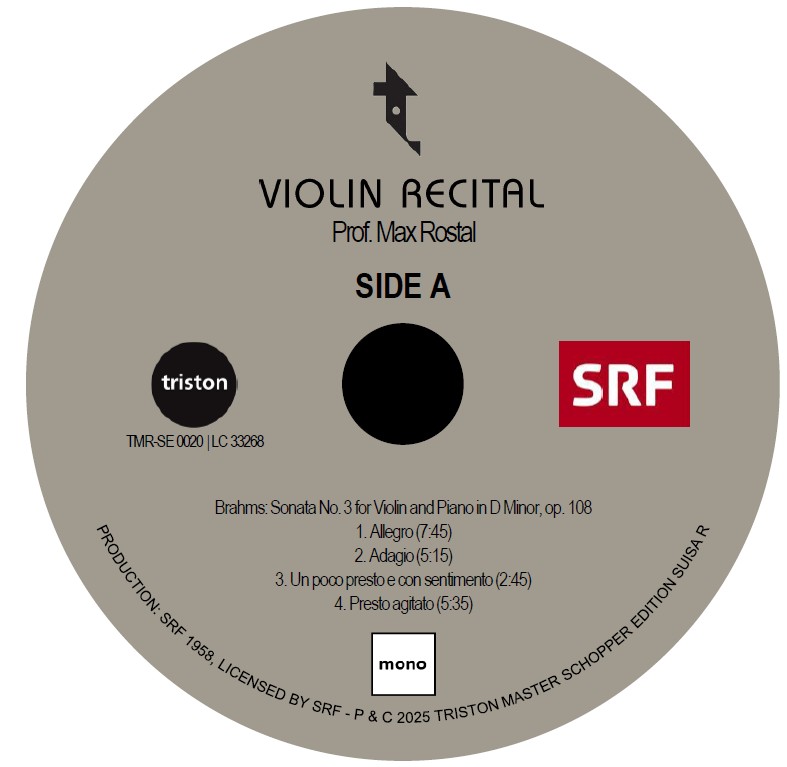
Side A:
Brahms: Sonata No. 3 for Violin and Piano in D Minor, op. 108
1. Allegro (7:45)
2. Adagio (5:15)
3. Un poco presto e con sentimento (2:45)
4. Presto agitato (5:35)
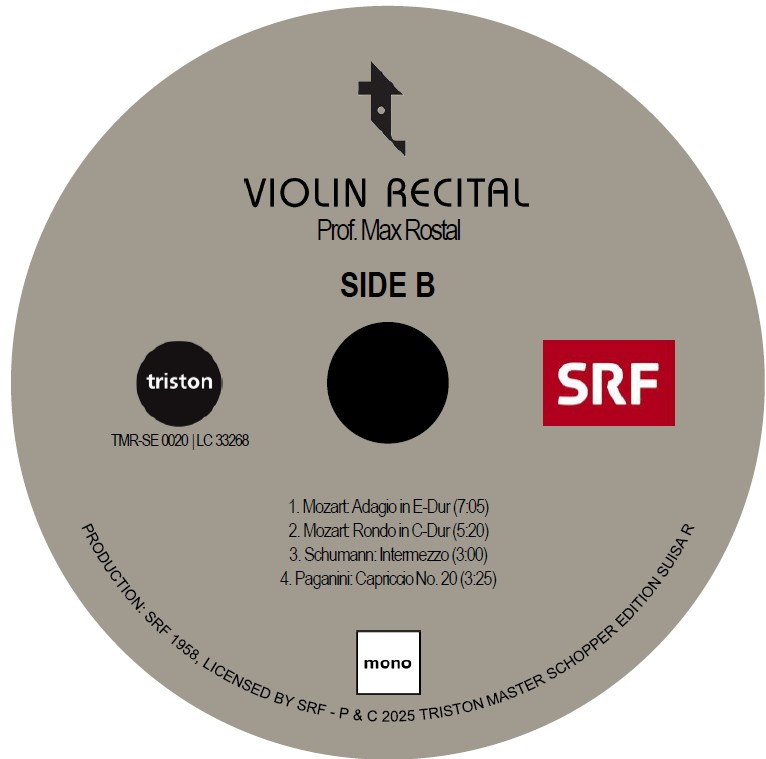
Side B:
1. Mozart: Adagio in E-Dur (7:05)
2. Mozart: Rondo in C-Dur (5:20)
3. Schumann: Intermezzo (3:00)
4. Paganini: Capriccio No. 20 (3:25)
Vinyl Cut: Simon Kummer von vinylaudio, Schweiz - www.vinylaudio.ch
Pressing: MEK Vinyl, Gossau, Schweiz - www.mekvinyl.ch
Producer: SCHOPPER AUDIO, Jürg Schopper, Schweiz, - www.schopper.ch
This album is an exact reproduction of the original master tape. In order to guarantee the best possible sound quality, no digital equipment or post-processing has been used.
It is a hand-numbered limited edition of 250 copies.
Test pressings are available on request.
Price: on request
Please order by e-mail:

Review Rostal by Stephen Lee Hong Kong
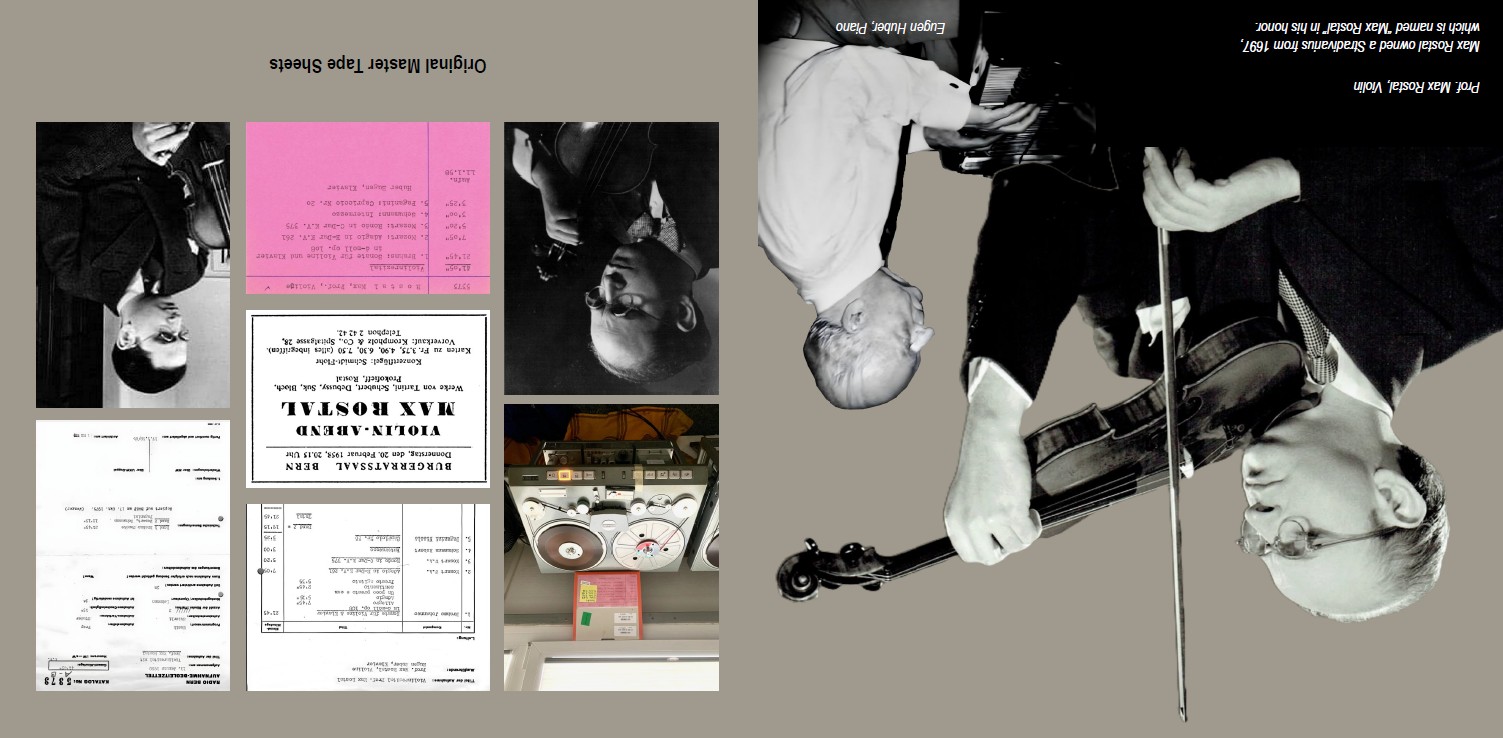
Ma x Rostal (1905-1991) of Austria was a violinist and violist renowned for his consummate technique, delicate tone and for its refined purity. Rostal studied under the celebrated Hungarian violin pedagogue Carl Flesch in his formative years. He became a professor at Berlin's University of the Arts in the early 1930s before relocating to London, England. His frequent appearances on BBC radio and worldwide concert tours established him as a “renowned British violinist”. Due to health concerns, he returned to German-speaking regions in the late 1950s, accepting a professorship at Cologne's Conservatory of Music before settling in Switzerland. In 1958, at the invitation of Radio Bern, he performed Brahms' Sonata No. 3 in D minor, Mozart's Adagio in E major and Rondo in C major, Schumann's Intermezzo, and Paganini's 20th Caprice. The Swiss label “Triston” acquired the original open-reel master tape of his January 1958 performance for Radio Bern and pressed it onto vinyl, making it exceptionally valuable.
Listening to the first side of the record, Brahms' Sonata No. 3 in D minor, the opening movement immediately reveals his expressive vibrato and lively rhythm, as if the music leaps from his bow. The final movement, “Allegro agitato,” with its brisk tempo and often performed as a standalone piece, radiates a Heifetz-like brilliance.
The second side showcases Mozart's elegant Adagio, the serene Rondo, the confessional Schumann Intermezzo, and Paganini's Caprice. These pieces not only highlight Max Rostal's exceptional artistry but also capture the unique improvisational spirit of live performance. Overall, each work displays rich expressiveness and captivating appeal. Special mention must be made of Eugen Huber's piano accompaniment. This Hungarian pianist, who occasionally composed works for others or created pieces for specific repertoire, provides perfectly measured support for the violin here. His rare quality lies in his seamless rapport with Max Rostal, closely following the ever-shifting rhythmic nuances with understated mastery.
During the 1950s, Max Rostal frequently used two renowned instruments: a Guarneri del Gesu and another Stradivarius, the latter being the one Zhao plays today. Truthfully, it's rare today to hear this uniquely timbred, now priceless early Stradivarius (1697-made Stradivarius Max Rostal Ex) that Rostal played during his lifetime. It possesses a distinctive, luminous, and gentle tone with remarkable density and penetrating power. Since this performance was broadcast and the recording was archived, no one has had the privilege of hearing it for over half a century. Now, the Swiss label “Triston”, specializing in unearthing rare recordings, has produced an authentic-sounding vinyl pressing for audiophiles, limited to just 250 copies worldwide! Discerning connoisseurs now have the opportunity to experience the true sound of this priceless instrument and top-tier performance through this faithful reproduction.
Review Rostal by Ernest Lau, July 2026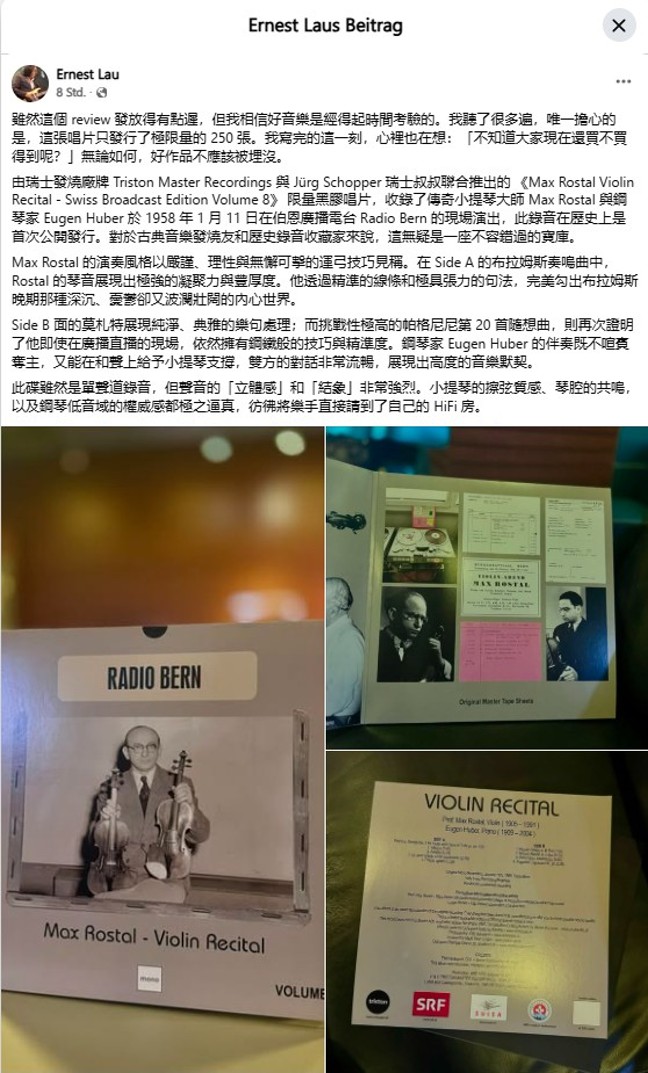 Although this review is a little late in coming, I believe that good music stands the test of time. I’ve listened to it many times over, and my only concern is that this record has been released in an extremely limited run of just 250 copies. As I finish writing this, I can’t help but wonder: ‘I wonder if anyone can still get hold of a copy?’ In any case, a fine piece of work should not be overlooked.
The limited-edition vinyl record *Max Rostal Violin Recital – Swiss Broadcast Edition Volume 8*, jointly released by the Swiss audiophile label Triston Master Recordings and Jürg Schopper, features a live performance by the legendary violinist Max Rostal and pianist Eugen Huber at Radio Bern on 11 January 1958. This recording is being released to the public for the very first time. For classical music enthusiasts and collectors of historical recordings, this is undoubtedly a treasure trove not to be missed.
Max Rostal’s playing style is renowned for its rigour, rationality and impeccable bowing technique. In the Brahms sonata on Side A, Rostal’s tone displays remarkable cohesion and richness. Through precise lines and highly expressive phrasing, he perfectly captures the profound, melancholic yet sweeping inner world of Brahms’s late period.
The Mozart on Side B displays a pure and elegant phrasing; whilst the highly challenging 20th Caprice by Paganini once again demonstrates that, even during a live radio broadcast, he possesses steely technique and precision. Pianist Eugen Huber’s accompaniment is neither overpowering nor intrusive, yet provides harmonic support for the violin; the dialogue between the two is exceptionally fluid, demonstrating a high degree of musical rapport.
Although this recording is in mono, the ‘sense of depth’ and ‘sound imaging’ are exceptionally vivid. The texture of the violin’s bowing, the resonance of the instrument’s body, and the authority of the piano’s lower register are all rendered with remarkable realism, as if the musicians had been invited directly into one’s own hi-fi room.